Gothamist
A non-profit newsroom, powered by WNYC.
Gothamist
Listen Live
News
Infographic: How Much Of The NYC Subway Is Accessible?
By
Clarisa Diaz
Published Mar 5, 2020
Share
FacebookTwitterRedditEmail
Never miss a story
Email address
By submitting your information, you're agreeing to receive communications from New York Public Radio in accordance with our Terms .

Clarisa Diaz, Gothamist/WNYC
By
Clarisa Diaz
Published Mar 5, 2020
Share
FacebookTwitterRedditEmail
We rely on your support to make local news available to all
Make your contribution now and help Gothamist thrive in 2026. Donate today
Gothamist is funded by sponsors and member donations
With only approximately 25% of its 472 stations accessible, the MTA has said it hopes to make NYC’s subway system 100% accessible by 2034 through the Fast Forward program. However, mapping the current and planned accessible stations under Fast Forward shows how much work the MTA still has ahead of it.
After the first phase of Fast Forward tackles 70 stations by 2024, the MTA will still have about 287 stations to make wheelchair accessible.
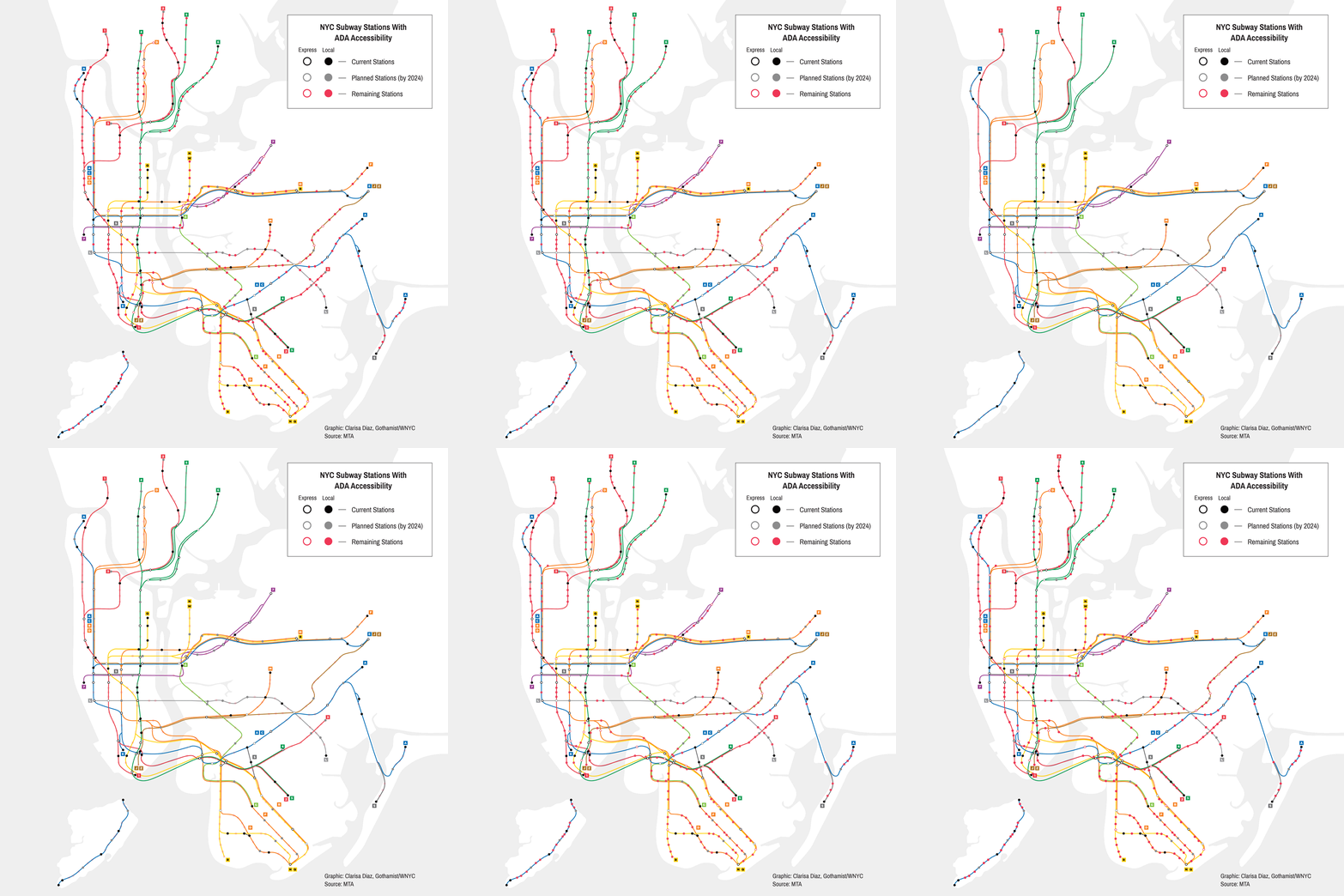
That means to reach the goal of 100% accessibility by 2034, the MTA would need to make around 143 stations ADA accessible for each of the next capital plans (2025-2029 and 2029-2034). The MTA "would have to be working on this right now at a much larger scale,” said Jessica Murray, a PhD candidate at CUNY who studies the impacts of transportation on people with disabilities. At the current pace of 70 stations every five years, it would be more like 2044 when the entire system could be fully accessible.
The idea that, as the MTA states in its Fast Forward plan, “no rider will be more than two stops away from an accessible station within five years," or by 2024, seems unlikely given that so many stations won’t be accessible by then—and over half of the city’s ADA-compliant stations would continue to be mostly concentrated in Manhattan.
There’s also an issue of scale: two stations away in Manhattan is a much shorter distance than two stations away in other boroughs. “In Brooklyn, that could be a mile away,” Murray said. But it’s not easy for wheelchair users to get around in Manhattan either: there’s only one accessible station on the entire Central Park periphery, and most accessible stations are in lower Manhattan or the Upper East Side. In reality, there are probably far fewer accessible stations than the MTA claims, with some stations only accessible in one direction, elevators going out-of-service on a daily basis without notice, and a lack of accessible transfers.
Areas like Sunset Park, the Bronx, and Astoria are relative transit deserts, even with new station renovations. Further, with transfer stations counted as key stations, some stops are counted multiple times in the MTA’s plan. “They [the MTA] got away with a little bit of trickery by saying Times Square is technically five stations,” explained Murray.
Despite counting multiple stations at a stop and counting all the stops the MTA says are or will be accessible, a line-by-line breakdown shows the actual accessibility of subway lines is approximately 29% or lower. The worst line in the city for accessibility is the G, followed by the W, J, R, and N lines. “You need a subway stop at the beginning and end of your trip. So if you can only get to 40% of the stations at the beginning and 40% at the end, you can only make 16% of the trips an able-bodied person can make [on the same line],” described Murray.
Here’s the full breakdown:
Clarisa Diaz, Gothamist/WNYC. Source data from the MTA.
The MTA’s position for decades has been that elevators are too expensive and too cumbersome to install in stations, but Murray points out there may be another reason that has factored into the failure to install elevators. “I think they’ve always looked at it as, ‘How many people are actually using wheelchairs? Can we really justify spending yada yada millions (it used to be millions now it’s billions) of dollars for 1% of the population?’ Forget about the fact that it’s a human right and a civil right, forget that they’ve received federal funding for all their capital construction programs and the ADA was intended to have this gradual enforcement over time. You don’t have to make it accessible overnight, but you should have a plan.”
As Murray and many other advocates put it, accessibility is for everyone.
To find accessible stations near you, check out Murray’s Google map:
Clarisa Diaz is a designer and reporter for Gothamist / WNYC. You can follow her on Twitter @Clarii_D.
Tagged
we the commuters
subway
accessibility
Clarisa Diaz
Read more
Gothamist is funded by sponsors and member donations
Gothamist is funded by sponsors and member donations
MORE news

Central Park birders, others remember 63-year-old woman killed in park
The NYPD has not publicly identified her. People who knew her said she was an artist and a familiar presence in the Ramble.

By
Charles Lane
Published Sep 28, 2026 at 7:04 p.m. ET

Dump truck driver hits and kills cyclist on 34th Street in Midtown, NYPD says
It's the latest in a string of hit-and-run deaths in the city in recent months.
By
Liam Quigley

News
Dump truck driver hits and kills cyclist on 34th Street in Midtown, NYPD says
It's the latest in a string of hit-and-run deaths in the city in recent months.
By
Liam Quigley
New ingredient mandated for Latin American kitchen, restaurant plates in NJ
By
Arya Sundaram
A Brooklyn jail cell filled with smoke. The emergency button failed, a lawyer said.
By
Samantha Max
Crews launch tunnel machines to dig first new Hudson River rail tunnels since 1910
By
Michael Sol Warren
Never miss a story
Catch up on the most important headlines with a roundup of essential NYC stories, delivered to your inbox daily.
Sign upEmail address
By submitting your information, you're agreeing to receive communications from New York Public Radio in accordance with our Terms .