Gothamist
A non-profit newsroom, powered by WNYC.
Gothamist
Listen Live
Arts & Entertainment
Where Did The Nickname 'The Big Apple' Come From?

By
Alec Hamilton
Published Jan 21, 2020
Share
FacebookTwitterRedditEmail
Never miss a story
Email address
By submitting your information, you're agreeing to receive communications from New York Public Radio in accordance with our Terms .

Shutterstock
By
Alec Hamilton
Published Jan 21, 2020
Share
FacebookTwitterRedditEmail
We rely on your support to make local news available to all
Make your contribution now and help Gothamist thrive in 2026. Donate today
Gothamist is funded by sponsors and member donations
While the origins of the nickname "The Big Apple" are not widely known, a local historian believes he has traced it back to a conversation between stable hands in the Big Easy, a hundred years ago.
Historian Barry Popik has spent three decades trying to understand where the phrase came from. He traces its first mention as a reference for New York City to January 1920, though the earliest record of that usage wouldn’t appear in print for a few years yet.
In February of 1924, John J. Fitz Gerald, a columnist covering horseracing for the New York Morning Telegraph, debuted a new column he called: Around the Big Apple.
In it, Fitz Gerald wrote "The Big Apple, the dream of every lad who ever threw a leg over a thoroughbred and the goal of all horsemen. There's only one Big Apple, that's New York."
Fitz Gerald goes on to credit his own use of the phrase to something he'd overheard at the New Orleans fairgrounds, where he recalled two stable hands (who he described as Black, though that's not the term he used) were "engaging in desultory conversation."
"'Where y'all goin' from here?' queried one. 'From here we're headin' for the big apple.' proudly replied the other. 'Well you better fatten up them skinners, or all you'll get from the apple will be the core' was the quick rejoinder."
Through racing records, Popik dates that conversation to January 1920, a hundred years ago. But the name of the stable hand has been lost to history.
Popik finds that a shame. He’s pushed for recognition of some sort—for the anonymous stable hands, for the New Orleans racetrack, for Fitz Gerald’s former home and his grave.
"The Mayor's Fund should pay for a proper grave stone for Fitz Gerald, who died in Manhattan," Popik told Gothamist/WNYC. "[He is] buried in Menands, New York. NYC could give him an iconic tombstone as a token of thanks, but nothing has been done."
However, Fitz Gerald has not gone totally unrecognized—in 1997, the “Big Apple Corner” was dedicated at West 54th Street and Broadway, a corner chosen because Fitz Gerald lived in a building there for thirty years. Popik says there was also a plaque on the Hotel Ameritania, installed in 1996, that "was taken off during renovations about a year later and is still missing."
He told us that in addition to the missing-plaque, and the still-existing street sign, "I have suggested that there be a 'Big Apple' in the pavement (like the stars on Hollywood Boulevard, or the books on the New York Public Library's 'Library Walk"). I have also suggested a high tech history hotspot, where tourists can point a smartphone and get the 'Big Apple' story in [different languages]." He says the Mayoral Advisory Commission on City Art, Monuments and Markers never responded to these suggestions.
Big Apple Corner
Google Maps
There have been other origin stories, too. A 1909 book, The Wayfarer in New York, uses the term, but without quotes, suggesting it's a metaphor, not a nickname. In the nineties a historian suggested the name was inspired by a prostitute named Eve, but Popik says that was a hoax.
Others have suggested jazz musicians get the credit. Popik says they did popularize it, but not until about a decade later. According to the Wall Street Journal, "In the 1930s, 'the Big Apple' spread to the Harlem jazz scene, becoming the name of two nightclubs as well as a popular song and dance."
Dr. Robert Snyder is the official borough historian for Manhattan. He says the nickname fell out of usage, but made a major comeback in the 1970s, when New York was struggling with a fiscal crisis. "People were looking around desperately and some of that seized that old phrase the Big Apple to remind people of when New York had been a strong and powerful city and might become that again," he told us.
It was at this time that the ad agency Ogilvy & Mather offered their help in creating campaign, pulling some inspiration from that old logo for Fitz Gerald's column.
The campaign was everywhere—here's an ad that ran in the Daily News selling Big Apple t-shirts:
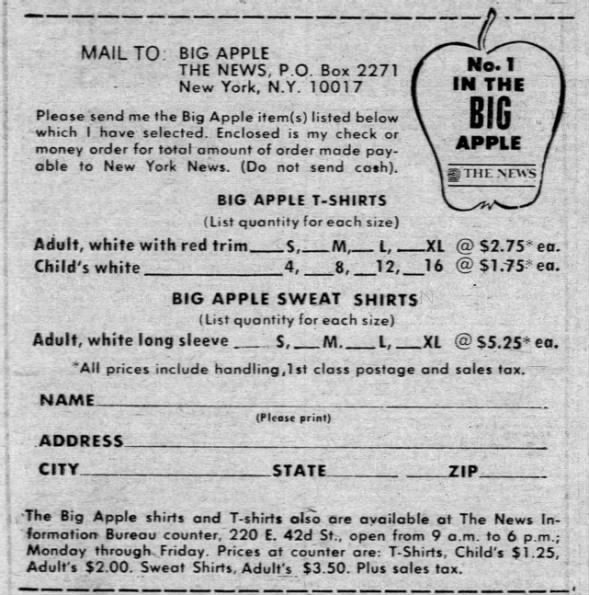 "No. 1 in the Big Apple" Daily News sweat shirts (1975). Sun, Jul 13, 1975 – 101 · Daily News (New York, New York) · Newspapers.com
Still, successful campaign aside, no one actually calls it "The Big Apple."
Tagged
history
big apple

Alec Hamilton
As the Senior Producer for Morning Edition on WNYC, Alec works hard to get listeners all the latest news and delightful stories from New York City, northern New Jersey and beyond. She loves a good music pun and wakes up very very early.
Read more
Gothamist is funded by sponsors and member donations
Gothamist is funded by sponsors and member donations
MORE arts-entertainment

Ever wish you could get paid to walk through a stranger’s house? ‘The Scout’ is for you.
A new film focuses on the strange career of a location scout in New York City.

By
Sonia Rao
Published Sep 26, 2026

There are 100s of places to visit during Open House New York. Here's 5 of our favorites.
See the entire lineup for the weekend when the city opens its doors.
By
Hannah Frishberg

Arts & Entertainment
There are 100s of places to visit during Open House New York. Here's 5 of our favorites.
See the entire lineup for the weekend when the city opens its doors.
By
Hannah Frishberg
A massive MTA archive ended up in a Virginia warehouse. A Brooklyn man brought it home.
By
Hannah Frishberg
How a Harry Styles pop-up in the East Village led to a nearby bookstore owner's arrest
By
Sonia Rao
NYC’s creative workers are increasingly self-employed, report says
By
Hannah Frishberg
Never miss a story
Catch up on the most important headlines with a roundup of essential NYC stories, delivered to your inbox daily.
Sign upEmail address
By submitting your information, you're agreeing to receive communications from New York Public Radio in accordance with our Terms .