Gothamist
A non-profit newsroom, powered by WNYC.
Gothamist
Listen Live
News
Queens Prosecutor Says Chanel Lewis Strangled Karina Vetrano: 'It Was A Run From Which She Would Never Return'

By
Max Rivlin-Nadler
Published Nov 6, 2018
Modified Nov 21, 2018
Share
FacebookTwitterRedditEmail
Never miss a story
Email address
By submitting your information, you're agreeing to receive communications from New York Public Radio in accordance with our Terms .

Gothamist
By
Max Rivlin-Nadler
Published Nov 6, 2018
Modified Nov 21, 2018
Share
FacebookTwitterRedditEmail
We rely on your support to make local news available to all
Make your contribution now and help Gothamist thrive in 2026. Donate today
Gothamist is funded by sponsors and member donations
Opening arguments in the trial of the man charged with the murder of Karina Vetrano began in Queens criminal court on Monday, more than two years after the 30-year-old speech pathologist was found dead in the weeds of a secluded park near her Howard Beach home after she went missing during what was supposed to be a short jog.
Chanel Lewis, the 20-year-old man arrested following a six-month investigation by the NYPD, faces up to 25 years in prison if convicted. The trial is expected to last until Thanksgiving and will hinge on whether the jury believes what the prosecution considers overwhelming evidence against Lewis, which includes a videotaped confession and apparent DNA matches to the crime scene, or if his Legal Aid defense team can convince the jury that the NYPD only built a case against Lewis because the high-profile murder, involving a family with strong ties to the NYPD, had gone unsolved for far too long.
With a cold November drizzle coming down outside the courthouse on Queens Boulevard, Judge Michael Aloise paced behind his chair in the packed courtroom as Assistant District Attorney Brad Leventhal delivered his almost two-hour long opening statement in a near-shout, laying out the evidence against Lewis.
Vetrano’s mother, Cathie Vetrano, and sister, Tana Vetrano, mouthed curses at Lewis as he slumped in his chair in an oversized tan suit. Throughout pre-trial hearings, and again on Monday, Lewis has repeatedly tried to glance back at his relatives seated behind him, only to be instructed to stare forward by court officers. Multiple times during the opening, Leventhal raced up to within a few feet of Lewis and shoved a finger in his direction.
“It was a run from which she would never return,” Leventhal told the strikingly young, diverse jury. In his opening, Leventhal set the scene of the early August day in 2016 where Vetrano went for a run in a park two blocks from the home she lived in with her parents, only to be found dead later that evening by her father, former FDNY firefighter Phil Vetrano. Her father had quickly contacted close friends within the NYPD to set off a manhunt for his daughter just a few hours after she didn’t return from her run.
“He strangled her. He strangled her until she was dead,” Leventhal said. Leventhal then walked the jury through the evidence against Lewis: three possible DNA matches to Vetrano’s neck, cell phone, and fingernails; a videotaped confession given after Lewis was in custody without a lawyer for at least twelve hours; and an ER trip the day after the attack that Lewis took with his father where Lewis had injuries to his hands consistent with those received from boxing.
There were also more curious claims that the prosecution had never shared with the defense before the trial but revealed during their opening statement—that Lewis had conducted internet searches on his cellphone about the murder before he was a suspect, and that he had also searched terms like “prosecutorial discretion” and “second chance” after he had been contacted by police.

Chanel Lewis after his arrest in 2017 (Katie Honan / DNAinfo New York)
Lewis’s Legal Aid team objected to several parts of the opening but were overruled by Judge Aloise (Aloise took over the case from former Judge Gregory Lasak, who stepped down from the bench earlier this year to run for District Attorney). At the end of Leventhal’s opening statement, defense lawyers moved for a mistrial based on a mischaracterization of the DNA evidence against Lewis, where the defense believed that Leventhal had told the jury details about the strength of the evidence that the prosecution's own experts would disagree with. They were overruled.
The investigation into Vetrano’s murder had dragged on for months after the NYPD had found DNA evidence at the crime scene that they were unable to match with any possible suspects. The Queens District Attorney’s office used the lack of a match to push for the state to allow familial DNA testing, a controversial tactic which would allow the NYPD to profile entire family networks based on their genetic heritage.
But, as prosecutors revealed during pre-trial hearings last November, the NYPD didn’t find Lewis through DNA testing—instead it was based on the recollection of an NYPD lieutenant who, while off-duty, followed a “suspicious character” walking around the traditionally cop-heavy neighborhood of Howard Beach over two months before the murder. Testifying last year, Lieutenant John Russo described that when he saw the same “suspicious character” the next day, he called it into his local precinct, who confronted and took the name of the individual — Chanel Lewis. The police then drove Lewis to Far Rockaway, a predominantly black neighborhood, but not the neighborhood where Lewis lived at the time, East New York. It is unclear why they did that — a judge ruled earlier this year that the stop, based on possible racial profiling by the NYPD lieutenant, was admissible.
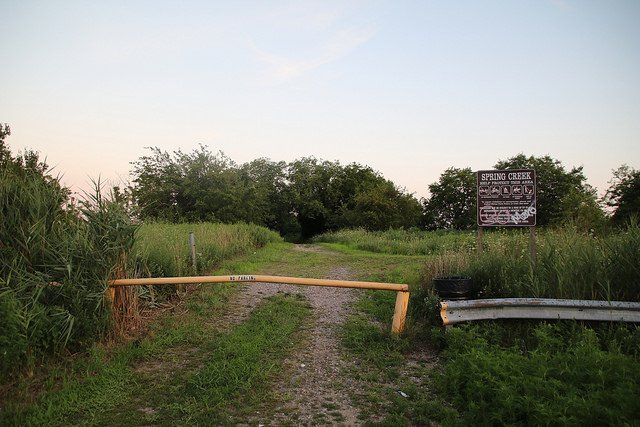
Spring Creek Park (Photograph by Richard York)
During her 15 minute opening, defense attorney Jenny Cheung drew the jury’s attention to Lewis’s interrogation, focusing on the six hours that Lewis was in police custody but wasn’t being videotaped, during which he decided to confess to the murder. Lewis’s defense team plans on looking at those missing hours as a time where Lewis, who had never spent a night away from his family, was possibly coerced by NYPD detectives into confessing, and why he gave two substantially different accounts of the murder to NYPD detectives and a prosecutor from the Queens DA office.
“Neither [of the confessions] will match the government’s story,” Cheung said.
The fact that Lewis had attended schools for students with learning disabilities went unmentioned in the defense’s opening, but will most likely come up during further testimony. Lewis’s lawyer have not ruled out that he might also testify in his own defense.
Cheung also instructed the jury to “pay close attention to the DNA evidence, and what it can tell you,” signaling that the defense will focus on the alleged certainty of the physical evidence.
Leventhal repeatedly objected to Cheung’s opening statement, with almost all of his objections sustained by Aloise, a judge who is viewed by defense lawyers who frequent the county courthouse as being deeply prejudiced in favor of prosecutors (Aloise’s daughter and son-in-law are both Queens ADA’s). The packed courtroom on Monday didn’t just include family members of the defendant, victim, and press, however — court staff unaffiliated to the case packed every available inch of the room.
After opening statements, the prosecution called two more witnesses — including a close friend of Phil Vetrano’s who was with him when he found his daughter's body. The prosecution introduced graphic photos of Karina’s remains in Spring Creek Park, leading to audible gasps and sobbing from her family. At this point, one juror appeared to signal that they were feeling unwell, and a brief recess was called to give jurors time to compose themselves.
The trial will resume on Wednesday.
Tagged
queens da
original
howard beach
far rockaway
chanel lewis
karina vetrano
east new york
queens

Max Rivlin-Nadler
Max Rivlin-Nadler has been a contributor to Gothamist since 2013. He has also reported for the New York Times, NPR, and The Intercept. His years-long investigation into New York City's arcane civil forfeiture laws led to a series of reforms which altered a practice that had been taking millions from poor communities for decades. Recently, he brought back a surfing habit from a few years on the west coast, and would love to see you all out in the Rockaways.
Read more
Gothamist is funded by sponsors and member donations
Gothamist is funded by sponsors and member donations
MORE news

Gatorade recall affects drinks sold in New York and New Jersey
More than 122,000 cases are being recalled over undeclared food dyes.

By
Giulia Heyward
Published Oct 5, 2026 at 4:36 p.m. ET

Gov. Hochul declares upstate NY measles outbreak a ‘disaster emergency’
The declaration is driven by rising case counts in rural areas and in neighboring Pennsylvania.
By
Caroline Lewis

News
Gov. Hochul declares upstate NY measles outbreak a ‘disaster emergency’
The declaration is driven by rising case counts in rural areas and in neighboring Pennsylvania.
By
Caroline Lewis
NYPD detective forced to retire after false statements in Brooklyn investigation
By
Charles Lane
Mamdani faces pressure to forge ahead with plan to fix polluting South Bronx market
By
Elizabeth Kim
Dominican man who shot border patrol officer in NYC sentenced to 15 years in prison
By
Samantha Max
Never miss a story
Catch up on the most important headlines with a roundup of essential NYC stories, delivered to your inbox daily.
Sign upEmail address
By submitting your information, you're agreeing to receive communications from New York Public Radio in accordance with our Terms .